A year ago, Historic Buildings & Places began a three-year journey to explore what the organisation might look like in the future. One year in, what have we learned?
When Historic Buildings & Places (HB&P) launched Future Lab in October 2025, we knew that the heritage sector was changing and that we needed to take time to think about how HB&P could respond. Developed in partnership with the Heritage Innovation Laboratory Oxford (HILO), the three-year project is exploring our purpose, culture and business models for the future.
Now, as we reach the end of year one, we have moved from asking questions to beginning to understand what some of the answers might look like.
In a recent online talk, HB&P Director Liz Power shared some of the thinking, research and conversations that have shaped the first year of Future Lab, as well as what comes next.
Starting with ourselves
The first year has been about understanding HB&P. Before we could think about where we want to go, we needed to understand where we are now.
We looked closely at what we do, grouping our work into four broad areas: casework and policy; outreach and engagement, including events, membership and communications; enabling others through partnerships, leadership and convening; and our academic and educational work, including training, publications and prizes.
We also looked at who we are trying to help and what problems we are trying to solve. As part of this, we invited our members, supporters and wider network to share their views through our 2026 supporters’ survey. We were delighted by the number of responses and grateful to everyone who took the time to tell us about their experiences of HB&P. Your continued support and engagement are hugely important to us.
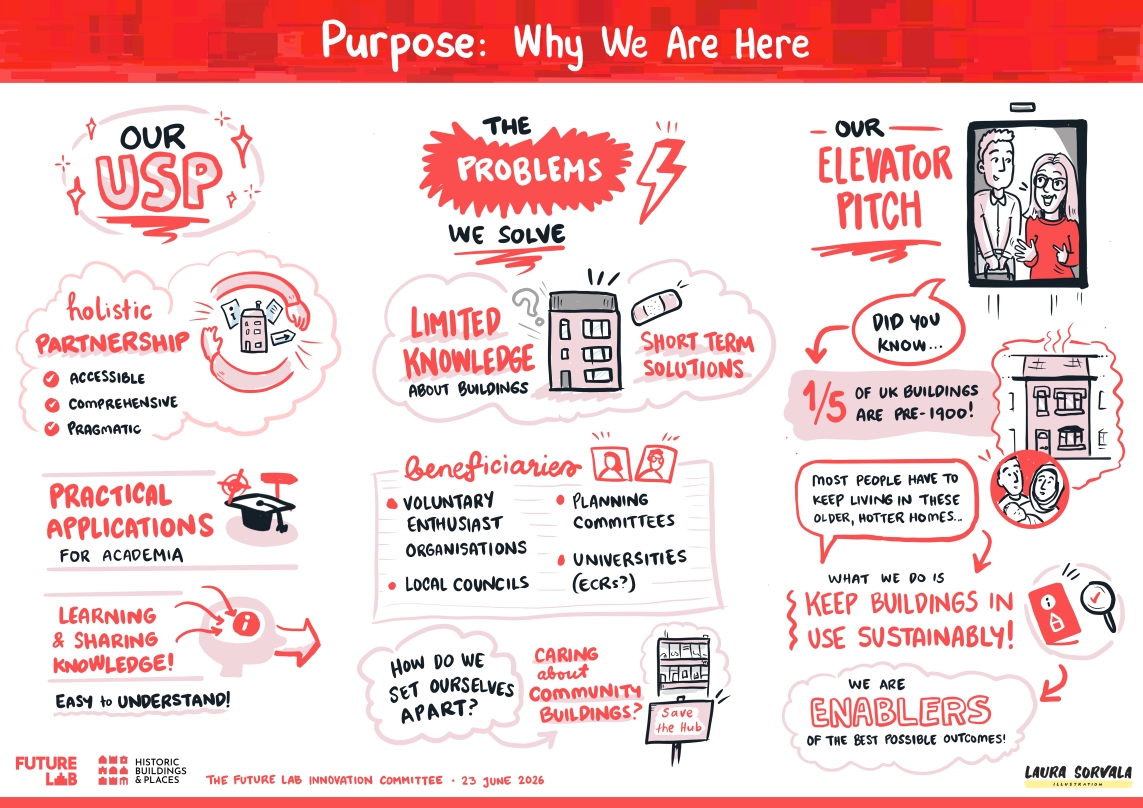
That process raised some challenging questions. We are a small organisation doing a lot of things for a lot of people. Our wide remit is one of our strengths, but it can also make it difficult to explain exactly what we do and where we can have the greatest impact.
Our research suggested that people generally value HB&P and its role, but that there is also some uncertainty about our identity and what we are trying to achieve. That has given us a clear challenge for the next stage of Future Lab: to become more focused and clearer about who our beneficiaries are, what problems we are trying to solve and how we can make the greatest difference.
From research to ideas
One of the most important parts of Future Lab has been the sheer breadth of research and evidence we have gathered.
This has included working with Worcester Polytechnic Institute (WPI) students exploring business models across the charity sector, research into membership, and a series of short micro-internships looking at areas including events, marketing, training and publications.
The research has produced some fascinating findings. For example, our work on green skills identified a potential gap between entry-level training and highly specialised postgraduate study. Research into academic publishing has explored different approaches to open access and society publishing. Other work has looked at our membership and how we might engage future generations of heritage professionals.
We have also commissioned research into heritage protection in the planning system, the relationship with ecclesiastical systems, and the history of the Ancient Monuments Society and its statutory role. Looking back at our history has been particularly valuable in helping us think about where we might go next.
You can explore some of these projects through our Future Lab news items and also read more about how Future Lab began.
Sharing the process
We have always wanted Future Lab to be an open process. Rather than disappearing behind closed doors for three years and emerging with a finished strategy, we are sharing what we are learning along the way.
That means showing the messy bits too: the questions, the research, the post-it notes, the workshops and the ideas that might not make it into the final plan.
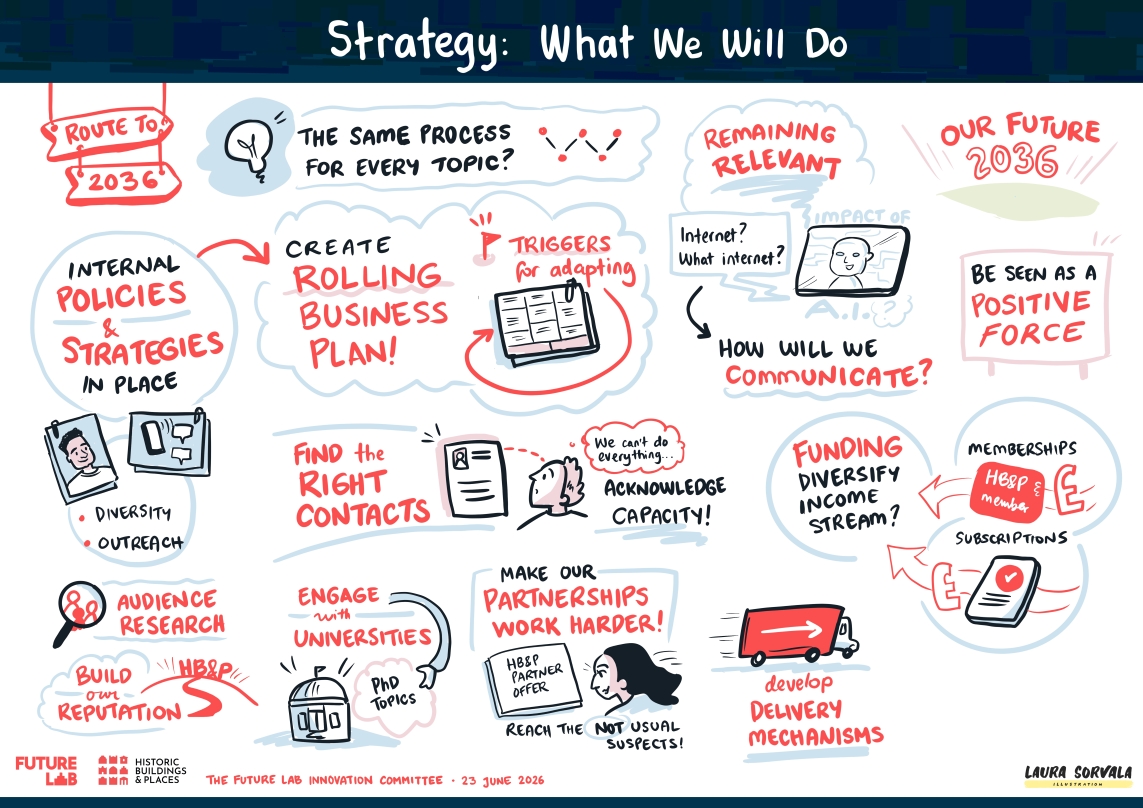
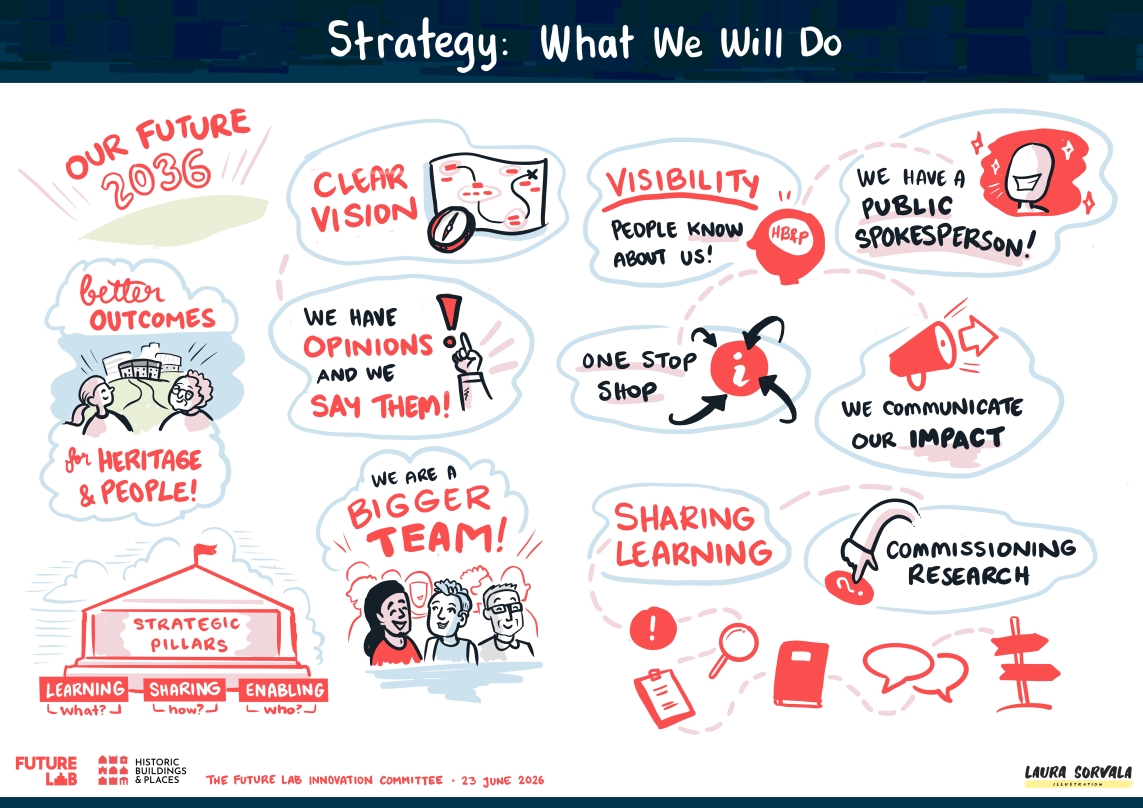
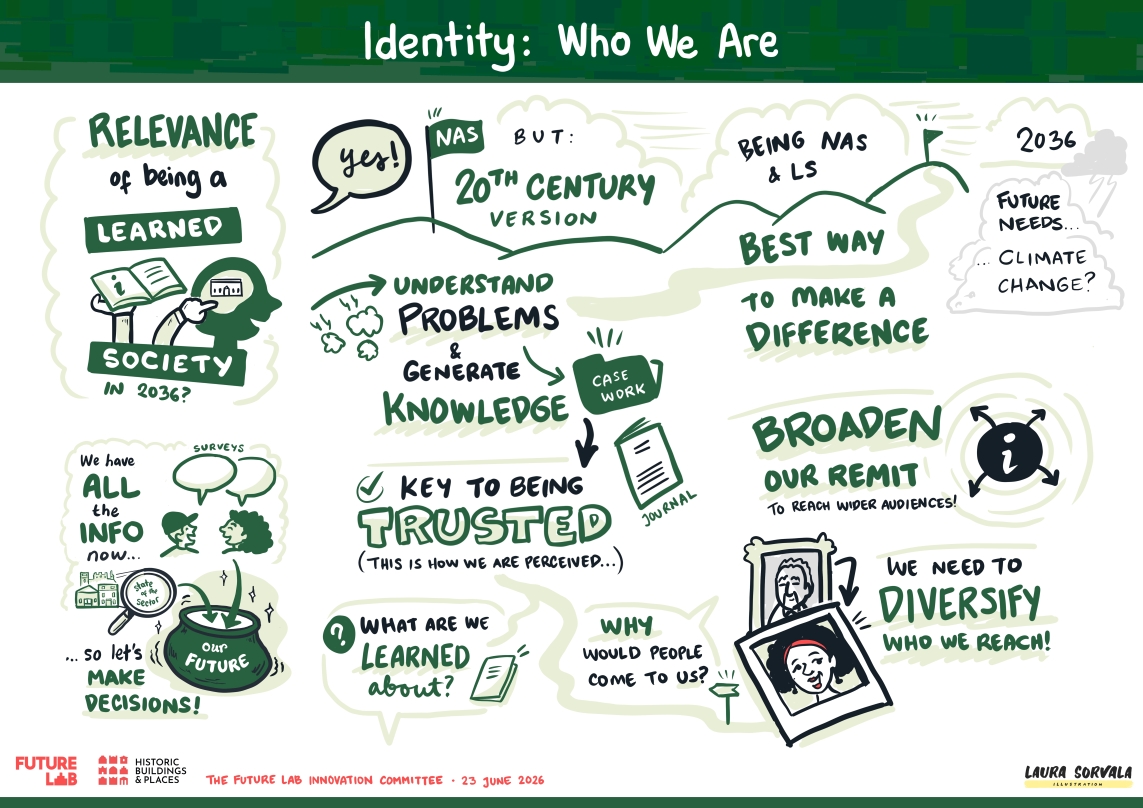
Our Future Lab Innovation Committee, or FLIC, has been central to this. Meeting quarterly, FLIC has helped turn all that research and information into ideas about what HB&P could become. We have also worked with illustrator Laura Sorvala to capture some of these conversations visually.
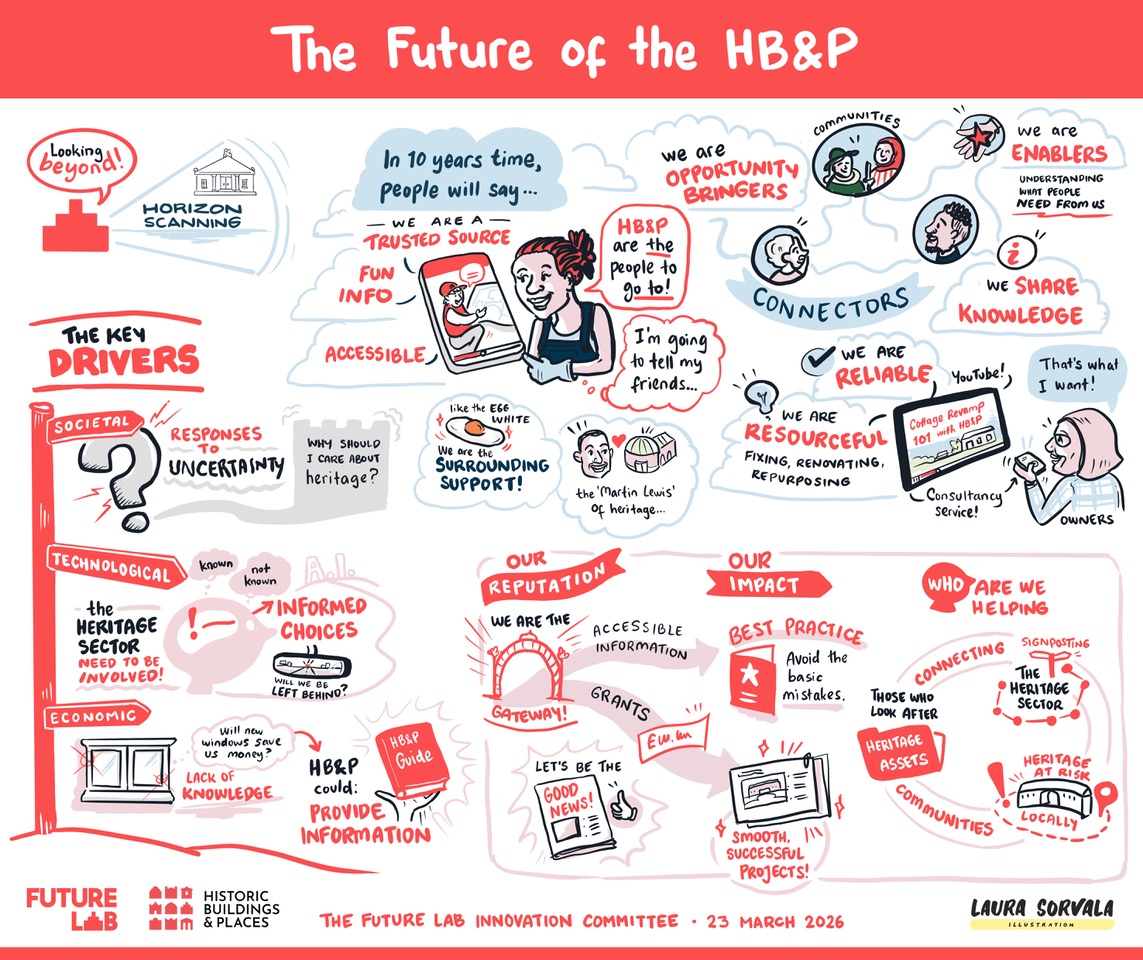
The illustrations have become a record of our thinking as it has developed. One session explored what HB&P might look like in ten years’ time, including how we could build on the trust and reputation we already have to become an organisation that people regularly turn to for trusted information and big ideas about heritage.
Another important strand of the conversation has been our history. Research reminded us that when the Ancient Monuments Society was founded in 1924, it was established as a learned society. We have started to explore what it could mean to embrace that role again for the 21st century, combining research and knowledge with effective communication and a strong public audience.
From these conversations, three ideas have begun to emerge as potential strategic pillars: learning, sharing and enabling.
You can see more of this thinking in Imagining the Future of HB&P: Inside FLIC.
So, what changes?
Future Lab is not about changing everything HB&P does. Our existing work continues, including our casework and our benefits to members and stakeholders.
Instead, it is giving us a new way of thinking about the organisation: using research, evidence and the views of our stakeholders to ask what we should be doing, why we are doing it and where we can have the greatest impact. We also hope it will provide us with a clearer understanding of our focus as an organisation.
It has already changed the way we work in some ways. We have developed new experience of managing research projects, working with students and freelance researchers, and building relationships across academia and the heritage sector.
It has also made us more comfortable with not having all the answers yet.
Looking ahead to Year Two
The next stage will be about taking some of the ideas generated during year one and exploring them in more detail.
We will be looking at the impact of our casework, including using Wales as a case study to understand its impact and speaking with conservation officers. We will be analysing planning data to identify trends that could help guide our work, and exploring how we might learn from disciplines such as science communication.
Other projects will look at learned societies, awards, academia, finance, audience development, leadership and business planning.
The aim is not to produce endless strategies and reports. As Liz put it during the talk, we want what we develop to be short, usable and actually able to be put into practice. We also know that the world is changing quickly, so our future plans need to be flexible enough to adapt.
After one year, we do not have a finished answer about the future of HB&P. That is not the point yet.
We have something more useful: a much better understanding of where we are, a growing body of research and evidence, a clearer sense of the questions we need to answer, and a growing collection of ideas about where we might go next.
And we will keep sharing how we get there.
Watch the Year One talk
If you would like to hear Liz Power talk through the first year of Future Lab, the full recording of Future Lab: One Year On: Progress, Learning and What’s Next is available to watch for free.
Future Lab will continue to develop over the next two years, and we will keep sharing the research, ideas, successes and lessons along the way.
Get Involved
If you are interested in getting involved in the Future Lab project, please contact us at office@hbap.org.uk.
Words by:
Christina Avramakis, HB&P Operations and Development Manager