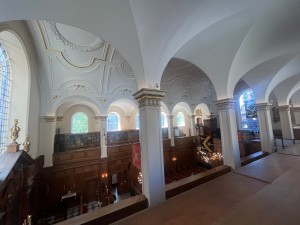
Back in May, in order to better inform my report on the history of Historic Buildings & Places, I travelled down to St Andrew by the Wardrobe (a lovely Grade I listed parish church on Queen Victoria Street in London and near the former headquarters of HB&P) to access some archival material stored in the upper galleries there. 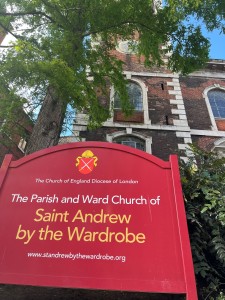
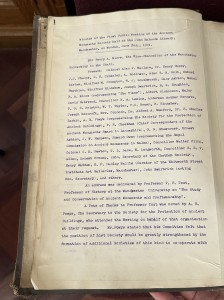
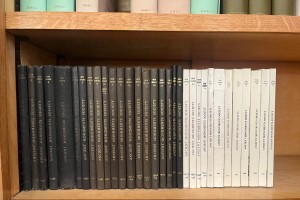
What I found was quite a treasure trove, the most significant volumes being a series of large tomes containing council minutes dating from the foundation of the Ancient Monuments Society over a century ago, in June 1924. The very first entry describes the initial ‘public meeting’ held at the John Rylands Library in Manchester, with the Society’s founder, John Swarbrick, in attendance alongside his friend and early conservation ally, Professor Thomas F. Tout, who gave a lecture on ‘The Study and Conservation of Ancient Monuments and Craftsmanship’.
Shortly after the first public meeting, the council assembled for the first time on 26 June at the same library, and the first officers of the Society were quickly appointed. The AMS evidently had an early and very close association with Manchester: its first President, the Earl of Crawford and Balcarres, was also Chancellor of the University, and the inaugural Chairman, Professor Robert Seymour Conway, was a distinguished classical scholar there. The council continued to meet frequently at the John Rylands Library, and by the 1950s had stored a sizeable collection of books and photographs at Manchester Central Library. Much of this collection is now believed to be at St Andrew by the Wardrobe and pertains to the organisation’s early functions as a learned society.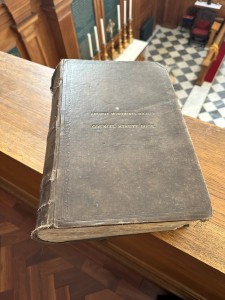
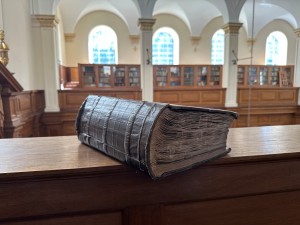
The council minute books also reveal more information about the Society’s move to London in 1952–53 and its amalgamation with a separate ‘National Ancient Monuments Society’, which John Swarbrick had established and registered at the same address as his architectural practice in Great Ormond Street. The organisation’s efforts then took on a distinctly national character, as evidenced by a new series of Transactions, a published journal which gave the AMS a platform to better showcase its expertise in matters pertaining to both conservation casework and legislative protection throughout England and Wales.
A trip to the archives likewise shone a spotlight on the many important people whose dedication to the Society drove its success in the second half of the twentieth century. A frequent name in the minute books is, of course, Ivor Bulmer-Thomas, who became the leading figure in securing the appointment of the AMS as a statutory consultee at the end of 1968. With these new responsibilities came dedicated new council members featured in the minutes, such as Dame Jennifer Jenkins, who was reportedly ‘head-hunted’ by Bulmer-Thomas to become Honorary Secretary in 1972.
It was no easy task to formulate a history of such a longstanding – and industrious! – organisation as HB&P, but its archive at St Andrew by the Wardrobe proved to be an invaluable resource, ripe for further study.
Words by:
Dr Amanda Westcott
Dr Amanda Westcott is an early career historian and researcher, recruited by the Future Lab to write a report on the history of HB&P. She is an Associate Member of the History Faculty at the University of Oxford and based in Edinburgh, currently developing her career in research consultancy, project management, and the heritage sector. Feel free to visit her online portfolio.