Each week, we ask one of the Worcester Polytechnic Institute (WPI) students working with Historic Buildings & Places (HB&P) and Heritage Innovation Laboratory Oxford (HILO) to share a short update on their project work and their time in London. Their research and analysis will help inform the development of Future Lab.
I’m Henry, one of the students from Worcester Polytechnic Institute working with HB&P and HILO on the Future Lab project. I’m originally from California, a little south of San Francisco. At WPI, I study biology and bioinformatics. On the team, I handle most of the data analysis and data visualization.
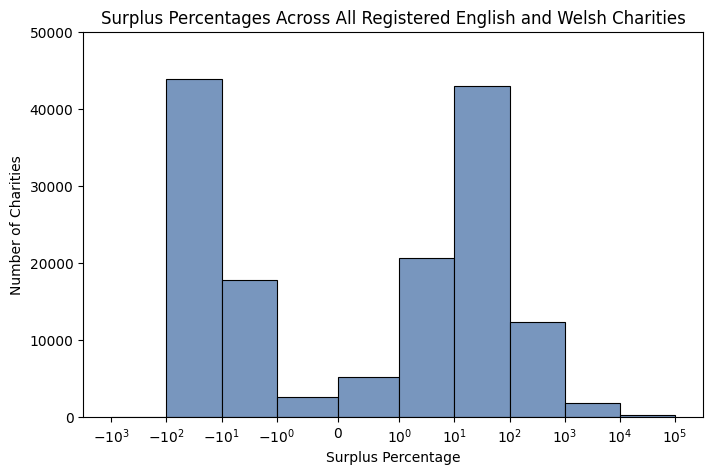
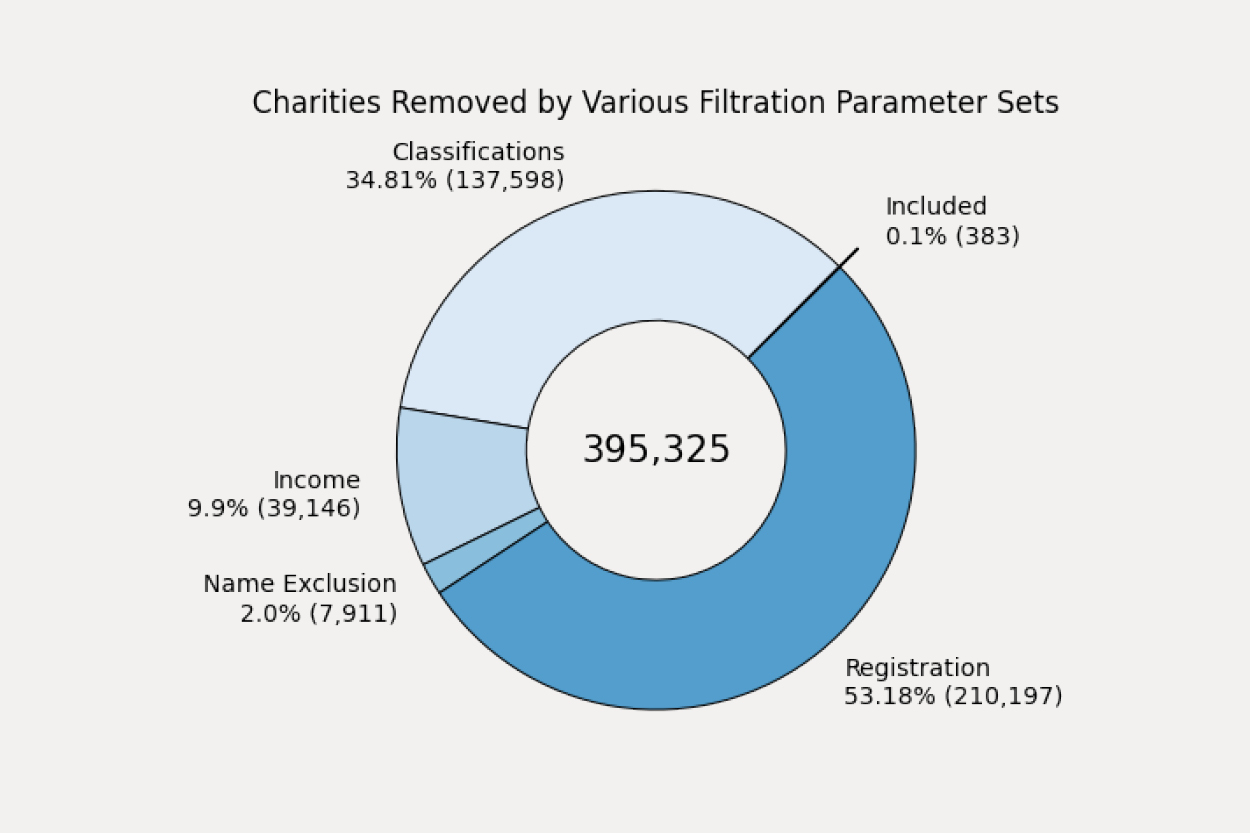
Our contributions to the Future Lab consist of two parts: analyzing the Charity Commission for England and Wales (CCEW) database and creating case studies on the business models of other charities. This week was the first phase of our project. I continued to filter the CCEW’s database to narrow down to possible charities for case study analysis. This filtration was done by excluding charities based on the provided classification and financial data, among other variables. This has narrowed down the list enough that my team and I are now able to look through the relatively short list to manually evaluate charities for case study analysis. I have also started using the CCEW’s data to create graphics to provide overviews of the whole charity and heritage charity sector. The graph below shows the distribution of surplus amounts, calculated by (Income – Expenditure)/(Expenditure) * 100. While the filtration phase of our project is coming to an end, the creation of these snapshots is likely to continue for at least a few weeks.
In the past two weeks, I have had an opportunity to learn new data analysis techniques. Beyond this, I have gotten to learn why we are here. The CCEW is a unique database with massive amounts of relevant information stored within it. Prior to our project, there has been no public record of people attempting to analyze the CCEW database. Without a doubt, it is a very daunting task. Through my analysis of the CCEW database and observation of its structure, it’s easy to understand why people without some computer science/data science experience would be intimidated by it. It contains useful information and insights, but there is simultaneously an overwhelming amount of data and not enough, as only each charity’s five most recent annual returns are publicly available. This makes it so only people with computer science/data science experience and enough time can derive useful insights.